
How important will COVID 19 safeguards in Commercial Offices
· Workplace · By Designo Interiors
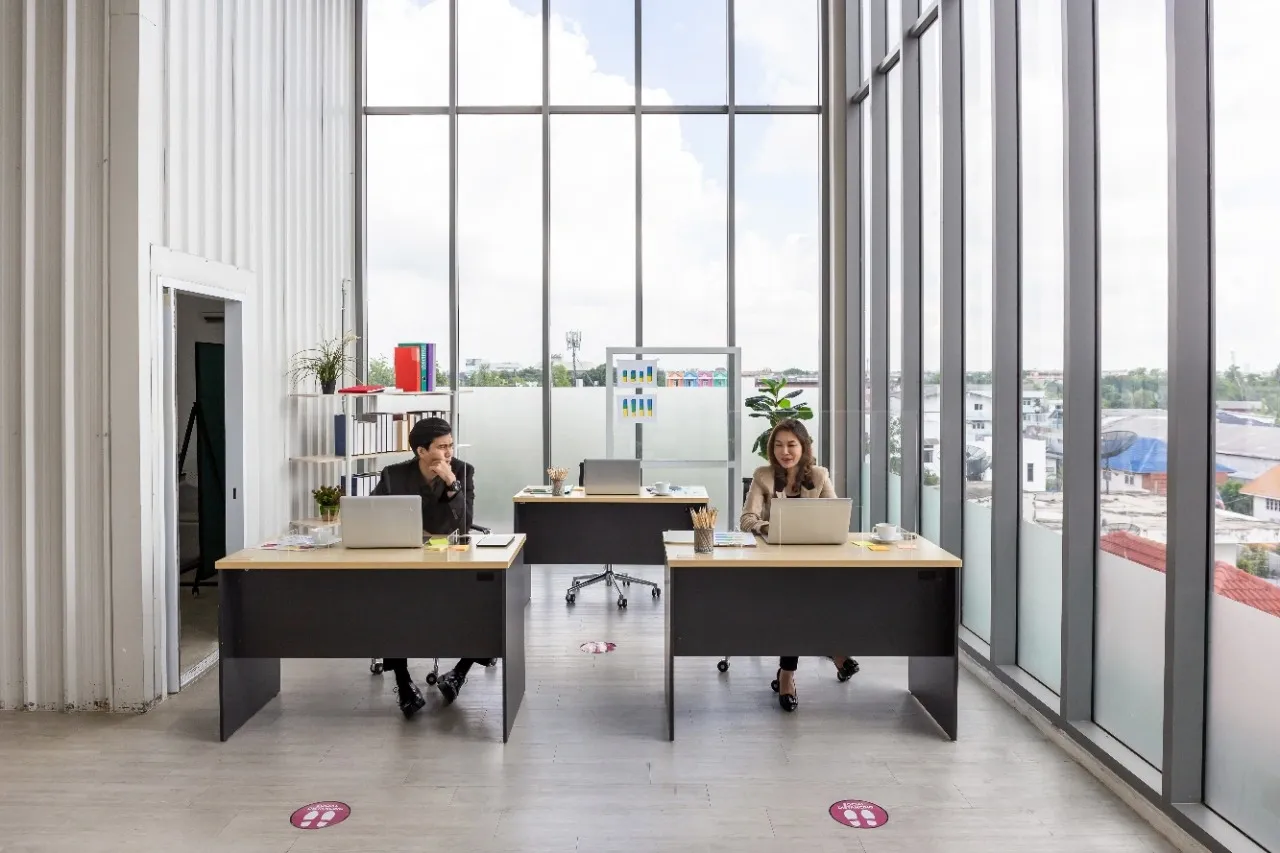
COVID-19 has brought extraordinary human and humanitarian encounters. Many companies around the world have risen to the instance, acting quickly to protect employees and wander to a new way of working that even the most thrilling business-continuity plans hadn’t intended by Interior Designing For Offices In Mumbai. In all industries, leaders will use the teachings from this large-scale work-from-home experiment to reimagine how work is done—and what role Interior Designing For Offices In Mumbai should play—in creative and bold ways.
Changing attitudes on the role of the office
Pre pandemic, the orthodox wisdom had been that Interior Designing For Offices In Mumbai were critical to productivity, culture, and winning the war for talent. Companies contested strongly for leading office space in major urban centres around the world, and many focused on solutions that were seen to endorse alliance by Interior Designing For Offices In Mumbai. Compaction, open-office designs, hoteling, and co-working were the battle cries which are considered by Commercial Office Interior Designer In Mumbai. But approximations suggest that early this April, 62 percent of employed Americans worked at home during the crisis,1 compared with about 25 percent a couple of years ago. During the pandemic, many people have been surprised by how rapidly and efficiently technologies for videoconferencing and other forms of digital collaboration were accepted. For many, the results have been better than imagined for Commercial Office Interior Designer In Mumbai. According to McKinsey research, 80 percent of people questioned report that they enjoy working from home. Forty-one percent say that they are more productive than they had been before and 28 percent that they are as productive due to Interior Designing For Offices In Mumbai.
Many employees unconventional from long commutes and travel have found more productive ways to spend that time, enjoyed greater flexibility in balancing their personal and professional lives, and decided that they prefer to work from home rather than the office. Many organizations think they can access new pools of talent with fewer locational restraints, adopt innovative processes to boost productivity, create an even stronger culture, and significantly reduce real-estate costs by Interior Designing For Offices In Mumbai. These same organizations are looking forward to the reviving and its challenges. Pre vaccine, the office experience probably won’t remain as it was before the pandemic.
Many companies will require employees to wear masks at all times, redesign spaces to ensure physical distancing, and restrict movement in congested areas (for instance, elevator banks and pantries). As a result, even after the reopening, attitudes toward offices will probably continue to evolve. But is it possible that the satisfaction and productivity people experience working from homes is the product of the social capital built up through countless hours of water-cooler conversations, meetings, and social engagements before the onset of the crisis? Will corporate cultures and communities erode over time without physical interaction? Will planned and unplanned moments of collaboration become impaired? Will there be less mentorship and talent development? Has working from home succeeded only because it is viewed as temporary, not permanent? The reality is that both sides of the argument are probably right. Every organization and culture is different, and so are the circumstances of every individual employee. Many have enjoyed this new experience; others are fatigued by it. Sometimes, the same people have experienced different emotions and levels of happiness or unhappiness at different times. The productivity of the employees who do many kinds of jobs has increased; for others it has declined. Many forms of virtual collaboration are working well; others are not. Some people are getting mentorship and contributing in casual, unintentional, and important conversations with colleagues; others are missing out.

1. Reconstruct how work is done
During the lockdowns, organizations have necessarily adapted to go on collaborating and to ensure that the most important processes could be carried on remotely like Interior Designing For Offices In Mumbai. Most have simply transplanted existing processes to remote work contexts, imitating Interior Designing For Offices In Mumbai had been done before the pandemic. This has worked well for some organizations and processes, but not for others. Organizations should identify the most important processes for each major business, layout, and function, and re imagine them completely, often with involvement by employees. This effort should examine their professional-development journeys (for instance, being physically present in the office at the start and working remotely later) and the different stages of projects (such as being physically co-located for initial planning and working remotely for execution).
Previously, for example, organizations may have generated ideas by convening a meeting, brainstorming on a physical or digital whiteboard, and assigning someone to refine the resulting ideas for Interior Designing For Offices In Mumbai. A new process may include a period of asynchronous thinking on a digital channel and integrating ideas from across the organization, followed by a multi hour period of debate and refinement on an open videoconference. Organizations should also reflect on their values and culture and on the interactions, practices, and rituals that promote that culture. A company that focuses on developing talent and workspaces by Interior Designing For Offices In Mumbai, for example, should ask whether the small moments of mentorship that happen in an office can continue spontaneously in a digital world. Other practices could be reconstructed and strengthened by Commercial Office Interior Designer In Mumbai so that the organization creates and sustains the community and culture it seeks.
Leading organizations will boldly question longheld assumptions about how work should be done and the role of the office when Commercial Office Interior Designer In Mumbai are designing it. Reimagining the office and work life after COVID-19 For both processes and cultural practices, it is all too appealing to return to what was in place before the pandemic. To resist this attraction, organizations could start by assuming that processes will be reconstructed digitally and put the burden of proof on those who argue for a return to purely physical pre–COVID-19 legacy processes. Reimagining and reconstructing processes and practices will serve as a foundation of an improved operating model that leverages the best of both in-person and remote work.
2. Decide ‘people to work’ or ‘work to people’
In the past couple of years, the competition for talent has been severer than ever. At the same time, some groups of talent are less willing to relocate to their employers’ locations than they had been in the past. As organizations reconstruct how they work and identify Commercial Office Interior Designer In Mumbai what can be done remotely, they can make decisions about which roles must be carried out in person, and to what degree. Roles can be reclassified into employee segments by considering the value that remote working could deliver: — fully remote (net positive value-creating outcome) — hybrid remote (net neutral outcome) — hybrid remote by exception (net negative outcome but can be done remotely if needed) — on site (not eligible for remote work) For the roles in the first two categories, upskilling is critical but talent sourcing may become easier by Interior Designing For Offices In Mumbai, since the pool of available talent could have fewer geographical constraints. In fact, talented people could live in the cities of their choice, which may have a lower cost of living and proximity to people and places they love, while they still work for leading organizations.
A monthly trip to headquarters or a meeting with colleagues at a shared destination may suffice. This approach could be a winning proposition for both employers and employees, with profound effects on the quality of talent an organization can access and the cost of that talent.
3. Redesign the workplace to support organizational priorities
We all have ideas about what a typical office looks and feels like: a mixture of private offices and cubicles, with meeting rooms, pantries, and shared amenities is handled by our Interior Designers For Offices In Mumbai. Few offices have been intentionally designed to support specific organizational priorities Commercial Office Interior Designer In Mumbai. Although offices have changed in some ways during the past decade, they may need to be entirely rethought and transformed for a post– COVID-19 world with the help of Commercial Office Interior Designer In Mumbai.
Organizations could create workspaces specifically designed to support the kinds of interactions that cannot happen remotely but is possible with the help of our Commercial Office Interior Designer In Mumbai. If the primary purpose of an organization’s space is to accommodate specific moments of collaboration rather than individual work our Commercial Office Interior Designer In Mumbai can help. For example, should 80 percent of the office be devoted to collaboration rooms? Should organizations ask all employees who work in cubicles, and rarely have to attend group meetings, to work from homes? If office space is needed only for those who cannot do so, are working spaces close to where employees live a better solution? Our Commercial Office Interior Designer In Mumbai use technology will play a central role in enabling employees to return to office buildings and to work safely before a vaccine becomes widely available.
Organizations will need to manage which employees can come to the office, when they can enter and take their places, how often the office is cleaned, whether the airflow is sufficient, and if they are remaining sufficiently far apart as they move through the space all these aspects are considered by our Commercial Office Interior Designer In Mumbai. To maintain efficiency, partnership, and knowledge and to preserve the corporate culture, the boundaries between being physically in the office and out of the office must fail. In-office videoconferencing can no longer involve a group of people staring at one another around a table while others watch from a screen on the side, without being able to participate effectively. Always-on videoconferencing, seamless in-person and remote collaboration spaces (such as virtual whiteboards), and asynchronous partnership and working models will quickly shift from futuristic ideas to standard practice.
4. Resize the footprint creatively
A transformational approach to reinventing offices will be necessary by our Commercial Office Interior Designer In Mumbai. Instead of adjusting the existing footprint incrementally, companies should take a fresh look at how much and where space is required and how it fosters desired outcomes for collaboration, productivity, culture, and the work experience by Interior Designing For Offices In Mumbai. That kind of approach will also involve questioning where offices should be located. Some companies will continue to have them in big cities, which many regards as essential to attract young talent and create a sense of connection and energy. Others may abandon big-city headquarters for suburban campuses. In any case, the coming alteration will use a portfolio of space solutions: owned space, standard leases, flexible leases, flex space, co-working space, and remote work. Before the crisis, flexible space solutions held about 3 percent of the US office market. Their share had been growing at 25 percent annually for the past five years, so elasticity was already in the works.
McKinsey research indicates that commercial office-space decision makers expect the percentage of time worked in main and satellite offices to decline by 12 and 9 percent, respectively, while flex office space will hold approximately constant and work from home will increase to 27 percent of work time, from 20 percent with the help of Interior Designing For Offices In Mumbai. These changes may not only improve how work is done but also lead to savings. Rent, capital costs, facilities operations, maintenance, and management make real estate the largest cost category outside of compensation for many organizations. In our experience, it often amounts to 10 to 20 percent of total personnel-driven expenditures. While some organizations have reduced these costs by thinking through footprints—taking advantage of alternative workplace strategies and reviewing approaches to managing space—many corporate leaders have treated them largely as a given. In a post–COVID19 world, the potential to reduce real-estate costs could be significant.
Simply getting market comparable lease rates and negotiating competitive facilities-management contracts will not be enough. Real-estate groups should collaborate with the business and HR to redo the footprint entirely and develop fit-for-purpose space designs quickly—in some cases, by creating win–win approaches with landlords and Interior Designing For Offices In Mumbai. The value at stake is significant. Over time, some organizations could reduce their real-estate costs by 30 percent. Those that shift to a fully virtual model could almost eliminate them by Interior Designing For Offices In Mumbai. Both could also increase their organizational resilience and reduce their level of risk by having employees work in many different locations.
More on this: Turnkey office fit-out